 TripGuru
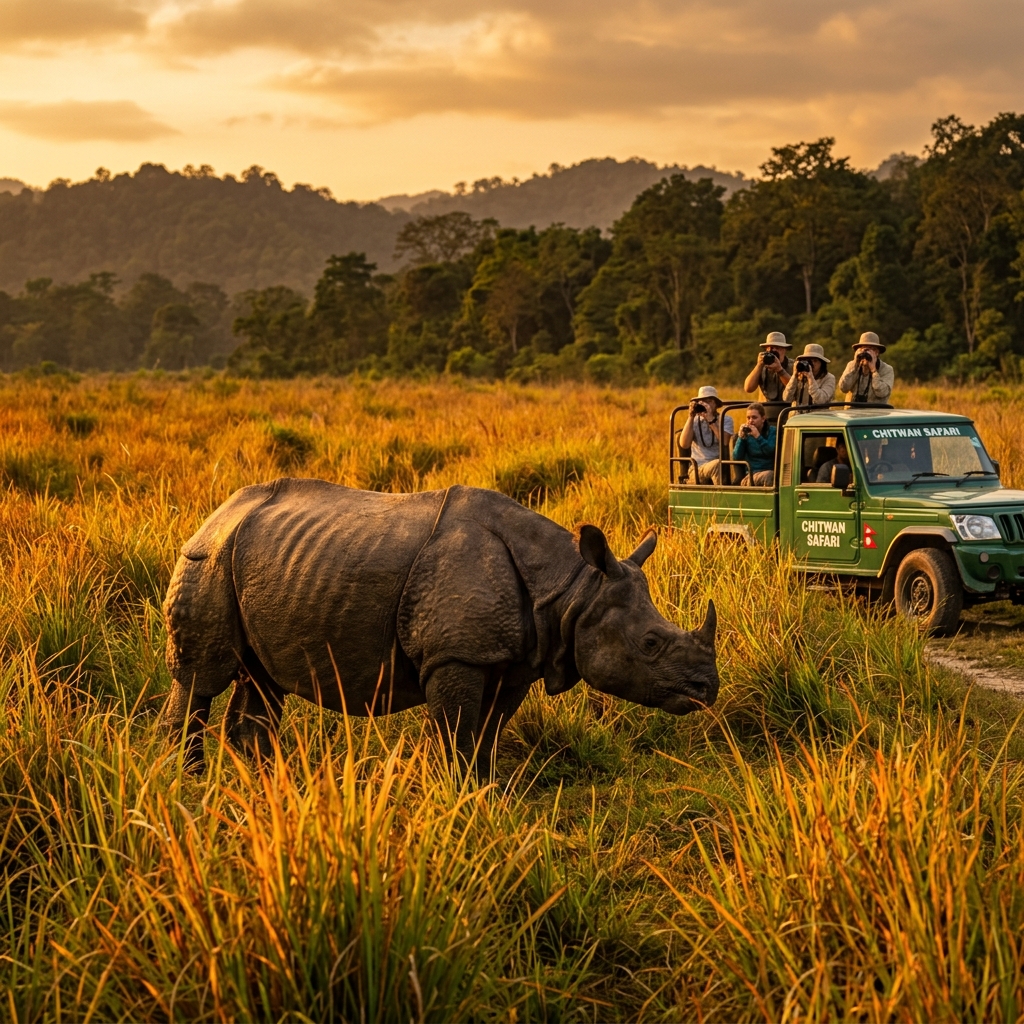
For a Chitwan National Park safari, combine a jeep drive (best for rhino and the rare tiger sighting), a short canoe ride on the Rapti River (for gharial crocodiles and birds) and a guided jungle walk (for a slower, on-foot feel of the forest). Stay in Sauraha village, visit between October and early March, and fit it in as a natural stop between Kathmandu and Pokhara rather than a separate detour.
| Best time to visit | Mid-Nov to early March (clearest); October is a good lush second option but among the busiest months — book ahead |
|---|---|
| Typical duration | 2 nights/3 days standard; 3 nights/4 days for a relaxed pace |
| Park entry fee (Indian/SAARC) | ≈ NPR 1,000 per person (about ₹625), as of 2026 |
| ID required | Adults: valid passport or original EC Voter ID card (no visa needed; Aadhaar/PAN generally not accepted). Rules for children and seniors can differ — confirm with the Indian Embassy in Kathmandu |
| How to reach | Road from Kathmandu (~175 km, 5–6 hrs) or Pokhara (~145–180 km, 3–5 hrs); also a short flight from Kathmandu to Bharatpur |
| Main base | Sauraha village on the park's eastern edge; premium lodges near Meghauli/Kasara on the west side |
Chitwan is the one part of a Nepal trip where the plan is built around animals, not temples. You get up before dawn, climb into a jeep or a dugout canoe, and go looking for a one-horned rhino standing in the mist on a riverbank, or a gharial crocodile sunning itself on a sandbar. Most people who build a Nepal itinerary around Kathmandu and Pokhara add Chitwan almost as an afterthought — it deserves better than that, because it sits conveniently between the two and because nowhere else in Nepal gives you this kind of wildlife at this kind of ease.
This guide covers the three main ways to see the park — jeep, canoe and walking safari — which one suits which traveller, when to go, where to stay, and how to fit Chitwan into a Kathmandu–Pokhara circuit without wasting a day on the road.
Jeep, canoe or walking safari — which should you pick?
Most two- or three-night trips do all three, in a mix spread over a couple of mornings and afternoons, because each one shows you something different.
| Safari type | What it's for | Typical length | Best for |
|---|---|---|---|
| Jeep safari | Covering ground deep inside the core park on fixed forest tracks, with a government-approved guide | Half a day | Rhino sightings (near-certain), the best (though still not guaranteed) chance of a tiger |
| Canoe safari | A dugout canoe drift down the Rapti River | About 45 minutes to an hour | Gharial and mugger crocodiles basking on the banks, kingfishers, herons and egrets |
| Jungle walk | A guided walk through forest and grassland on foot | Half a day to a full day (up to about 8 hours) | A quieter, slower feel for the jungle — birdsong, deer, langurs, and the chance of close-range rhino or sloth bear encounters |
Jeep safari is the one most first-time visitors want, because it goes furthest into the park and gives you the best odds of the big sightings — rhinos are seen on the great majority of jeep drives, while a tiger is a genuine bonus that most visitors still don't get, whatever the brochure photos suggest. One thing worth knowing before you book: jeep safaris inside the core park are typically suspended for about three months every monsoon (roughly June/July to September), when flooding and fallen trees make the forest tracks unsafe. Jeep and other activities in the buffer zone and community forests around the park usually continue, so this mainly affects the deep-park drive. Check current conditions with your operator before you travel if you're visiting in that window.
Canoe safari is short but memorable — gliding silently down the Rapti at dawn, watching a gharial slide off a sandbank, is a different pace entirely from a jeep. Chitwan holds a significant share of Nepal's remaining gharial crocodile population, so this is one of the better places in the country to see them. It's usually sold as an add-on rather than a half-day activity in itself.
Jungle walk is for travellers who want to actually feel the forest rather than watch it go past a jeep window. Two licensed naturalist guides are compulsory, you walk in a group, wear neutral (not bright) clothing, and follow the guide's instructions at all times — if you come face to face with a rhino or a bear, the guides' call on what to do matters more than instinct. No one is allowed inside the park on foot between sunset and sunrise. Walks continue through the monsoon months when jeep safaris are paused, which makes this the main activity if you visit Chitwan in the rains.
A note on elephant safaris: you'll still see them advertised in Sauraha, but Nepal's elephant-safari tradition is currently under active review by courts, conservationists and tourism operators over animal welfare concerns, and the situation could change. We'd suggest sticking to jeep, canoe and walking safaris, and asking your operator for the current position if you're curious about elephant activities.
Best time to visit Chitwan National Park
The clearest, driest window is mid-November to early March: thin undergrowth, good visibility, comfortable daytime temperatures. An annual grass-cutting opens up sightlines in the park in February–March each year.
October, right after the monsoon ends, is a good second choice — the jungle is lush and green and rainfall has mostly stopped — but October/November visitor numbers are in fact among the highest of the year at Chitwan, so book ahead rather than assuming it's quiet.
Avoid the heart of monsoon (roughly June to September) if jeep safari deep into the park is your priority — tracks can be waterlogged or blocked by fallen trees, and jeep safari inside the core park is usually suspended for visitor safety during this stretch. It's a good season for birders and for jungle walks, since this is also peak breeding season for much of the park's wildlife.
How many days do you need?
Two nights, three days is the standard package and enough to do one jeep safari, one canoe ride, and either a jungle walk or a visit to a watchtower, plus an evening Tharu stick-dance show in Sauraha village.
Three nights, four days gives you a more relaxed pace — a morning and an evening jeep drive rather than just one, time to try all three safari types without rushing, and a buffer if weather or flooding disrupts a day's plan. If wildlife is the main reason for your Nepal trip, this is worth the extra night.
Where to stay — Sauraha or a buffer-zone resort
Sauraha, the village on the park's eastern edge along the Rapti River, is where almost everyone stays. It has guesthouses through to comfortable mid-range resorts, restaurants, and easy access to the park gate, canoe put-in point and jeep pickup. As of October 2026, indicative nightly rates run roughly ₹750–1,250 for budget guesthouses, up to roughly ₹1,500–5,600 for mid-range resorts — these are approximate booking-site ranges, not fixed prices, so confirm the current rate when you book.
A handful of premium jungle lodges sit inside or adjacent to the park's buffer zone further west, near Meghauli and Kasara. These are quieter, closer to the core forest, and priced from roughly ₹9,300 a night upward as of October 2026. They suit travellers who want fewer people around and don't mind paying more for the setting.
For most families and first-time visitors, Sauraha is the easier, better-value base — it's where the canoe and jeep points are, and where the evening cultural programme happens.
How to combine Chitwan with Kathmandu and Pokhara
Chitwan sits almost exactly on the road between Kathmandu and Pokhara, which is why nearly every circuit itinerary runs Kathmandu → Chitwan → Pokhara, or the reverse, rather than treating Chitwan as a separate detour.
- Kathmandu to Chitwan (Sauraha): around 175 km by road, roughly 5–6 hours depending on traffic and road conditions on the Mugling route.
- Chitwan to Pokhara: sources differ a little depending on the route taken, putting it at roughly 145–180 km and about 3–5 hours by road.
- Kathmandu to Pokhara direct (if you're skipping Chitwan on the way back): about 200 km, typically 6–9 hours by road, sometimes longer, depending on traffic and ongoing highway works — check current conditions before you travel.
Chitwan also has its own small domestic airport at Bharatpur with short flights from Kathmandu, useful if you're tight on time — check current flight schedules and fares directly with the airline or a booking site, since these change often.
If you're coming from Gorakhpur or anywhere in eastern UP, the nearest border crossing is Sunauli–Bhairahawa. From there it's roughly 4–5 hours by road via Butwal and Bharatpur to Sauraha — our Sunauli border guide covers that crossing in detail. A practical loop for an India-based traveller looks like: cross at Sunauli, go straight to Chitwan for your safari, then continue to Pokhara and Kathmandu (or the reverse), flying out of Kathmandu at the end. Our places to visit in Kathmandu guide is a useful add-on for the city end of the trip, and you can map out the whole route — Chitwan included — on the Nepal trip planner.
What it costs — entry fees and typical package prices
Official park entry fees for Indian nationals (as SAARC-category visitors) are published in Nepali rupees and have stayed at the same level for some years: around NPR 1,000 per person (roughly ₹625) for park entry, with a jeep safari activity fee of around NPR 5,000 per jeep (about ₹3,100), usually split among 4–6 passengers — rates can vary by operator, so confirm before booking. These figures use an exchange rate of about 1 INR ≈ 1.60 NPR as of mid-2026; the rate moves, so treat this as indicative.
Canoe safari doesn't appear to have a separately published government fee — it's generally bundled into a day-tour or package price rather than charged on its own, so don't expect a standalone rate at the gate.
Third-party tour packages covering 2 nights/3 days with accommodation, meals and activities typically range from around ₹15,000–21,000 per person for budget-to-mid-range stays, up to around ₹27,000–28,000 per person where the package includes extra activities, based on operator listings seen in 2026. These are retail prices from tour operators, not fixed rates, so get a current quote before you commit — message us on WhatsApp and we'll put together a Chitwan plan with firm pricing for your dates.
Documents Indians need for Chitwan
Indians don't need a visa to enter Nepal, under the longstanding India–Nepal treaty arrangement. For identity, Indians typically need a valid passport or original Election Commission of India Voter ID card to travel to Nepal; Aadhaar and PAN cards are generally not accepted for adults. Rules for children and senior citizens can differ and have changed before, so confirm the current position with the Indian Embassy in Kathmandu before you travel. This is enforced strictly for air travel; land border posts are sometimes described as more relaxed, but it's safest to carry a passport or original voter ID regardless of how you cross. A printed or photocopied voter ID is not a substitute for the original card.
No separate permit is needed for Chitwan itself — just your park entry ticket and the relevant activity fee, bought at the park counter or through a licensed Sauraha operator.
Before you travel, check the latest advisory from India's Ministry of External Affairs (mea.gov.in) and the Indian Embassy in Nepal.
Safety and what to pack for the jungle
Wear neutral, dull colours — greens, browns, khaki — rather than bright clothing, since bright colours and white stand out to animals. Comfortable closed shoes, a hat, sunscreen, mosquito repellent and a light jacket for early-morning jeep rides (it's genuinely cold in the open jeep before sunrise, even in October) cover most of what you'll need. On a jungle walk, two licensed naturalist guides are compulsory and you must stay with the group and follow instructions immediately if wildlife is encountered at close range — this applies on every walk, whatever the season.
Chitwan is easy to enjoy without overplanning: book your accommodation and activities a few days ahead if you're travelling in October, November or around the Nepali New Year window in April–May when the park is at its busiest, and build in enough nights to try the jeep, the canoe and a walk rather than rushing through on a single morning drive.
Frequently asked questions
Which is better — jeep, canoe or walking safari in Chitwan?
Each shows you something different: the jeep covers the most ground and gives the best odds of rhino (and occasionally tiger) sightings, the canoe is a short river drift best for gharial crocodiles and birds, and the jungle walk is slower and on foot with two compulsory guides. Most two- or three-night trips combine all three.
Can you actually see a tiger in Chitwan National Park?
It's possible but not guaranteed. Rhino sightings happen on most jeep safaris, while a tiger sighting is a genuine bonus that most visitors don't get despite what tour brochures suggest.
What is the best time to visit Chitwan National Park?
Mid-November to early March is the clearest, driest window with the best visibility. October, right after the monsoon, is a good second option with a lush, green jungle, though October and November are among the park's busiest months by visitor numbers, so book ahead.
How many days do I need for a Chitwan safari?
Two nights, three days is the standard package and covers a jeep safari, a canoe ride and a jungle walk or watchtower visit. Three nights, four days gives a more relaxed pace with time for two jeep drives and no rush to fit everything in.
How do I get from Kathmandu to Chitwan, and from Chitwan to Pokhara?
Kathmandu to Chitwan (Sauraha) is about 175 km by road, roughly 5–6 hours. Chitwan to Pokhara is roughly 145–180 km depending on the route, about 3–5 hours. A short flight from Kathmandu to Chitwan's Bharatpur airport is also an option if you're short on time; check current schedules with the airline.
Is the elephant safari in Chitwan still available, and is it ethical?
Elephant safaris are still advertised in Sauraha, but the activity is currently under active review by Nepali courts, conservationists and tourism operators over animal welfare concerns, and the situation could change. We'd suggest sticking to jeep, canoe and walking safaris and checking the current position with your operator if you're interested.
What is the entry fee for Indian nationals at Chitwan National Park?
As of 2026, Indian nationals pay the SAARC-category entry fee of around NPR 1,000 per person (roughly ₹625), plus a jeep safari activity fee of around NPR 5,000 per jeep, usually split among passengers. Confirm current rates locally, as fees and operator charges can vary.
Do Indians need a visa or ID document for Nepal?
No visa is required for Indian nationals to enter Nepal. Adults typically need a valid passport or original Election Commission of India Voter ID card — Aadhaar and PAN cards are generally not accepted. Rules for children and senior citizens can differ, so confirm the current position with the Indian Embassy in Kathmandu before you travel.
Sources
- Jeep safari inside Chitwan National Park suspended for monsoon season — Kathmandu Post
- CNP bans tourism activities including commercial jungle driving inside Park — Himalayan Times
- Jungle Walk activity page — Windhorse Tours
- 45 minutes canoeing at Rapti River — Barahi Resort
- Where River and Jungle Collide: A Guide to Chitwan's Wild Heart
- Best Time to Visit Sauraha — Champion Traveler
- Tourists rise in Chitwan National Park — Onlinekhabar English
- Government raises visiting fees for Chitwan National Park — Himalayan Times
- Distance from Pokhara to Chitwan National Park — Wanderlog
- Elephant safaris at crossroads as Chitwan weighs ethical tourism shift — Kathmandu Post
- Indian Embassy Kathmandu — Consular Services
- Indian Rupee (INR) to Nepalese Rupee (NPR) historical exchange rate — ValutaFX
- The Best of Chitwan (5 days) itinerary reference — Kimkim
- Chitwan Tour Package (2 Nights, 3 Days) — Shanker Hotel Travel Desk
Rules, fees and timings change. We checked these facts on 16 October 2026; confirm visa and entry rules with the official source before you travel.