 TripGuru
Kathmandu's essential sights are the three Durbar Squares (Kathmandu, Patan, Bhaktapur), Pashupatinath temple, the stupas at Boudhanath and Swayambhunath, and the contrast between touristy Thamel and the working Asan bazaar. Two days covers the highlights; three days lets you add Bhaktapur properly and slow down. Entry fees are modest for Indian visitors, and no visa is needed, but carry a passport or Voter ID.
| Minimum time needed | 2 days for highlights, 3 days to add Bhaktapur properly |
|---|---|
| Best time to visit | September–November and March–May (clear, dry, 15–25°C) |
| Entry fees (Indian/SAARC) | NPR 250–500 per Durbar Square; Pashupatinath free; NPR 50–100 for the stupas (Indian/SAARC) |
| ID needed | Passport or Voter ID — Aadhaar alone not accepted for flights; no visa required |
| How to reach from Gorakhpur | Road via Sunauli border (long day/overnight) or flights via Varanasi/Delhi |
If you have three days in Kathmandu, you can't really see "everything" — but you can see enough to understand why people keep coming back. The old royal squares, the two big Buddhist stupas, the Hindu pilgrimage site on the Bagmati, and the contrast between Thamel's shopfronts and Asan's spice sacks together give you the valley's full range: faith, trade, craft and daily life, all within a half-hour taxi ride of each other.
This guide walks through what each place actually feels like, what it costs to enter as of October 2026, and a realistic way to fit them into two or three days without rushing from one UNESCO plaque to the next. If Kathmandu is one stop on a longer trip, TripGuru's Nepal holidays page has an overview of how it's usually combined with Pokhara or Chitwan.
The three Durbar Squares — and how they differ
Kathmandu Valley has three old royal squares, each its own UNESCO World Heritage Site, and each with a distinct character.
Kathmandu Durbar Square (also called Hanumandhoka or Basantapur) was the seat of the Malla and early Shah kings — a dense cluster of over 50 temples, courtyards and statues right in the middle of the modern city, a short walk from Thamel. This is where you'll find the Kumari Ghar, a three-storey red-brick building with carved wooden windows, home to the Kumari — a young Newar girl worshipped as a living goddess until she reaches puberty. You can enter the courtyard and sometimes catch her appearing briefly at an upper window, most often reported around mid-morning or late afternoon, though there's no fixed schedule and no guarantee. Photography or filming of her is strictly not allowed.
Patan Durbar Square, about 5–6 km south of Thamel (20–30 minutes by taxi, traffic depending), is smaller and arguably prettier — a tight square ringed with stone and metal craftsmanship, home to the Patan Museum and generations of Newar woodcarvers and metalworkers who still work in the surrounding lanes. If Kathmandu's square feels political, Patan's feels artisanal.
Bhaktapur Durbar Square, 13–15 km east of Kathmandu (30 minutes to over an hour depending on traffic), is the best preserved of the three and the most rewarding to simply wander. The old town around Taumadhi and Dattatreya squares is largely car-free, with potters' squares, tiered temples and street food stalls selling the local juju dhau (king curd) in clay pots. Give Bhaktapur more time than the other two — it rewards slow walking rather than a quick circuit.
Pashupatinath — the ghats, the aarti, and what non-Hindus can see
Pashupatinath, on the eastern edge of the city on the banks of the Bagmati river, is one of the most important Shiva temples in the Hindu world and a working pilgrimage and cremation site — not a museum piece. The pagoda-roofed inner sanctum is open only to Hindus. Non-Hindu visitors (relevant mainly for mixed family or friend groups) can still walk the wider complex — the ghats, gardens and surrounding shrines — and watch cremations and the evening aarti from the eastern bank across the river.
The complex is generally open from early morning to around 9pm, with the inner sanctum typically open mornings and reopening for the evening aarti — but published timings for the aarti vary between sources and even the temple trust's own schedules don't always agree. Ask your hotel or guide for that day's timing once you arrive, rather than planning around a fixed hour.
Entry is free for Indian and Nepali citizens; other foreign nationals pay around NPR 1,000.
Boudhanath and Swayambhunath — two very different stupas
These are both major Buddhist sites, and both worth visiting, but they feel nothing alike.
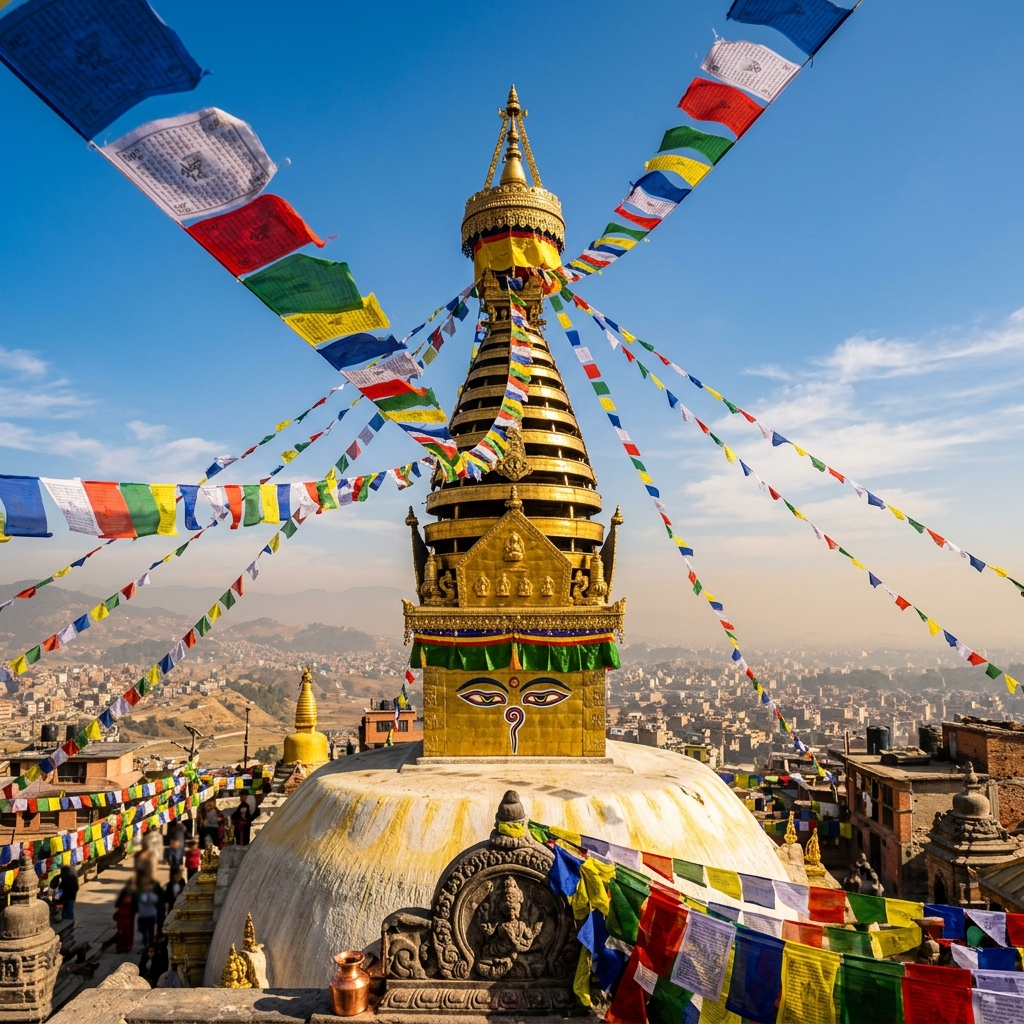
Boudhanath, in the north-east of the city, is one of the largest spherical stupas in the world and the centre of Kathmandu's Tibetan Buddhist community — monasteries, prayer-wheel-lined walkways and shops selling thangka paintings and singing bowls ring its base. It's flat and open, so it's an easy, social walk: go around dusk when monks and pilgrims do their evening kora (circumambulation) and butter lamps are lit around the stupa's base. It's open 24 hours, though daylight and dusk are when it comes alive.
Swayambhunath, on a hilltop on the western edge of the valley, is older and feels more like a pilgrimage climb — several hundred stone steps up (there's also a road route if you'd rather not climb), past resident monkeys that give the site its "Monkey Temple" nickname, to panoramic views over the whole Kathmandu valley. Go earlier in the day for clearer views and cooler steps; it's open roughly sunrise to sunset.
Entry fees for both are modest — as an Indian/SAARC visitor, expect to pay around NPR 50 at Swayambhunath and NPR 100 at Boudhanath; other foreign nationals pay more (NPR 200 and NPR 400 respectively). Carry small NPR notes, since fees can be revised and change over time.
Thamel and Asan bazaar — two sides of the same city
Thamel is Kathmandu's travellers' quarter: a tangle of narrow lanes packed with trekking-gear shops (genuine brands next to convincing knock-offs), souvenir and handicraft stores, bookshops, and restaurants doing everything from momo and dal bhat to Tibetan, Indian and Western food. It's where most visitors stay, and where the city's nightlife — bars, live music — picks up after dark. Treat it as your base and your evening wind-down spot rather than a sight in itself.
Asan bazaar (Asan Tole) is the old commercial heart of the city, a small circular plaza where six historic trade routes converge — part of the ancient corridor that once linked India, Nepal, Tibet and China. Unlike Thamel, Asan isn't dressed up for tourists: mornings bring sacks of dried chilli, turmeric, ginger, rice, lentils and dried fish piled outside Newari merchant houses, with small shrines and the Annapurna Temple (dedicated to the grain goddess) sitting right in the middle of the market chaos. Asan sits on the walking route between Kathmandu Durbar Square and Thamel, so there's no need for a special trip — just walk through it on your way between the two, ideally in the morning when the market is busiest.
How to fit it into 2–3 days
Two days is enough to hit the highlights without feeling rushed; three days lets you add Bhaktapur properly and slow down generally.
| Day | Morning | Afternoon/Evening |
|---|---|---|
| Day 1 | Kathmandu Durbar Square and the Kumari Ghar | Walk through Asan bazaar to Thamel; evening in Thamel for dinner |
| Day 2 | Swayambhunath early (cooler, clearer views) | Pashupatinath ghats, then Boudhanath for the evening kora and butter lamps |
| Day 3 (if you have it) | Bhaktapur Durbar Square — give it the whole morning | Patan Durbar Square on the way back, or a slower second look at Thamel/Asan |
If you only have two days, swap Bhaktapur and Patan into a single half-day — Bhaktapur first (it's further but more rewarding), with Patan as a shorter stop on the way back into town since it's roughly 13 km and 30–60 minutes from Bhaktapur by road. A taxi for the day, rather than switching between squares by separate rides, usually works out easier.
What it costs to enter (approximate, October 2026)
Fees for Indian nationals are generally lower than for other foreign visitors under SAARC-linked pricing, though a couple of these figures vary between sources, so treat them as a guide and keep some spare NPR notes on you.
| Site | Indian/SAARC visitor | Other foreign nationals |
|---|---|---|
| Kathmandu Durbar Square | NPR 500 | NPR 1,000 |
| Patan Durbar Square | NPR 250 | NPR 1,000 |
| Bhaktapur Durbar Square (covers Durbar, Taumadhi & Dattatreya squares, multi-day re-entry) | NPR 500 | NPR 1,800 |
| Pashupatinath | Free | NPR 1,000 |
| Boudhanath | NPR 100 | NPR 400 |
| Swayambhunath | NPR 50 | NPR 200 |
Budget hotel rooms around Thamel run roughly ₹3,400–3,800 a night, and mid-range hotels in the Thamel/Durbar Marg area roughly ₹7,600–8,900 a night, based on 2026 listings — these move with season and demand, so check current rates before you book.
Getting to Kathmandu, and what ID to carry
Indians don't need a visa for Nepal, under the 1950 Indo-Nepal Treaty — but you still need valid ID, and the rules differ by mode of travel. For flights, the Indian Embassy in Kathmandu's advisory accepts only a valid Indian passport or an original Voter ID card — Aadhaar, PAN and driving licence are not accepted for air travel. For land crossings such as Sunauli–Belahiya, passport or Voter ID are the official documents too; Aadhaar is sometimes accepted informally by border staff as extra proof but shouldn't be your only document. Children travelling with parents can generally use a birth certificate or school ID, but rules for minors differ, so confirm before you travel.
From Gorakhpur, the road route runs via the Sunauli border (about 90 km, 2–3 hours) into Bhairahawa, then on through Narayanghat and Mugling to Kathmandu — a long hill road best treated as an overnight or very long day's drive rather than a quick hop, since conditions vary. TripGuru's Gorakhpur travel agency page can help if you want this leg organised rather than self-driven. By air, Kathmandu is well connected from several Indian cities, including Varanasi and Delhi — check current flights, routes and fares with the airline, IRCTC, or your travel agent closer to your date. If you're travelling from the capital, TripGuru's Delhi travel agency team can also help put the booking together.
Before you travel, check the latest advisory from India's Ministry of External Affairs (mea.gov.in) and the Indian Embassy in Nepal.
Best time for this itinerary
Autumn (September–November) is peak season — clear skies, 15–25°C, and it overlaps with the Dashain and Tihar festivals, which add colour to the squares but also crowds. Spring (March–May) is the next best window, with similarly clear skies and rhododendrons in bloom. Winter (December–February) has cold nights but clear mountain visibility; monsoon (June–August) is hot and wet and the hardest season for a walking-heavy itinerary like this one.
If you'd rather not plan the day-by-day logistics yourself — which taxi route, which square first, where to stay near Thamel — TripGuru's Nepal trip planner can put together a Kathmandu itinerary around the sites in this guide, or message us directly if you want it combined with Pokhara or Chitwan.
Frequently asked questions
How many days do I need in Kathmandu?
Two days is enough for the main sights — Kathmandu Durbar Square, Thamel, Pashupatinath and Boudhanath or Swayambhunath. Three days lets you add Bhaktapur and Patan properly instead of rushing.
What's the difference between the three Durbar Squares?
Kathmandu Durbar Square was the political and royal centre, with the Kumari Ghar. Patan is known for its metal and stone craftsmanship. Bhaktapur is the best preserved and most walkable, with a largely car-free old town.
Can non-Hindus enter Pashupatinath?
The inner sanctum is open only to Hindus, but anyone can walk the wider complex — the ghats, gardens and surrounding shrines — and watch the evening aarti from across the river.
Do Indians need a visa for Nepal?
No. Under the 1950 Indo-Nepal Treaty, Indian citizens don't need a visa. You still need valid ID — a passport or Voter ID — especially for flights, since Aadhaar alone isn't accepted for air travel.
Is Boudhanath or Swayambhunath better?
They're different experiences rather than better or worse. Boudhanath is flat and social, built around Tibetan Buddhist community life. Swayambhunath is a hilltop climb with valley views and resident monkeys.
What's the difference between Thamel and Asan bazaar?
Thamel is the tourist quarter — shopping, restaurants and nightlife. Asan is the old working market, with spice and grain traders, not aimed at visitors at all. They're close enough to walk between.
Can you see the Kumari, Kathmandu's living goddess?
Sometimes — she occasionally appears at an upper window of the Kumari Ghar, though there's no fixed schedule or guarantee. Photography or filming of her is not permitted.
How do I travel between the three Durbar Squares?
A taxi is the easiest option. Patan is roughly 20–30 minutes from central Kathmandu, Bhaktapur 30 minutes to over an hour, and Patan to Bhaktapur about 30–60 minutes, all traffic-dependent.
Sources
- A Guide to the UNESCO World Heritage Sites of the Kathmandu Valley
- Entry fees of the heritage sites in Nepal
- Nepal attractions, fees & timings
- Pashupatinath Temple Visitor Guide
- Hanumandhoka entry fee hiked for tourists
- Kathmandu to Patan distance/travel time
- Kathmandu to Bhaktapur distance/travel time
- Bhaktapur to Patan distance/travel time
- Sunauli border crossing guide
- 10 Things to do in Thamel, Kathmandu
- Asan, Kathmandu — Wikipedia
- The Kumari Ghar — Nepal Traveller
- Best Time to Visit Kathmandu — SOTC
- Visa policy of Nepal — Wikipedia
Rules, fees and timings change. We checked these facts on 9 October 2026; confirm visa and entry rules with the official source before you travel.